

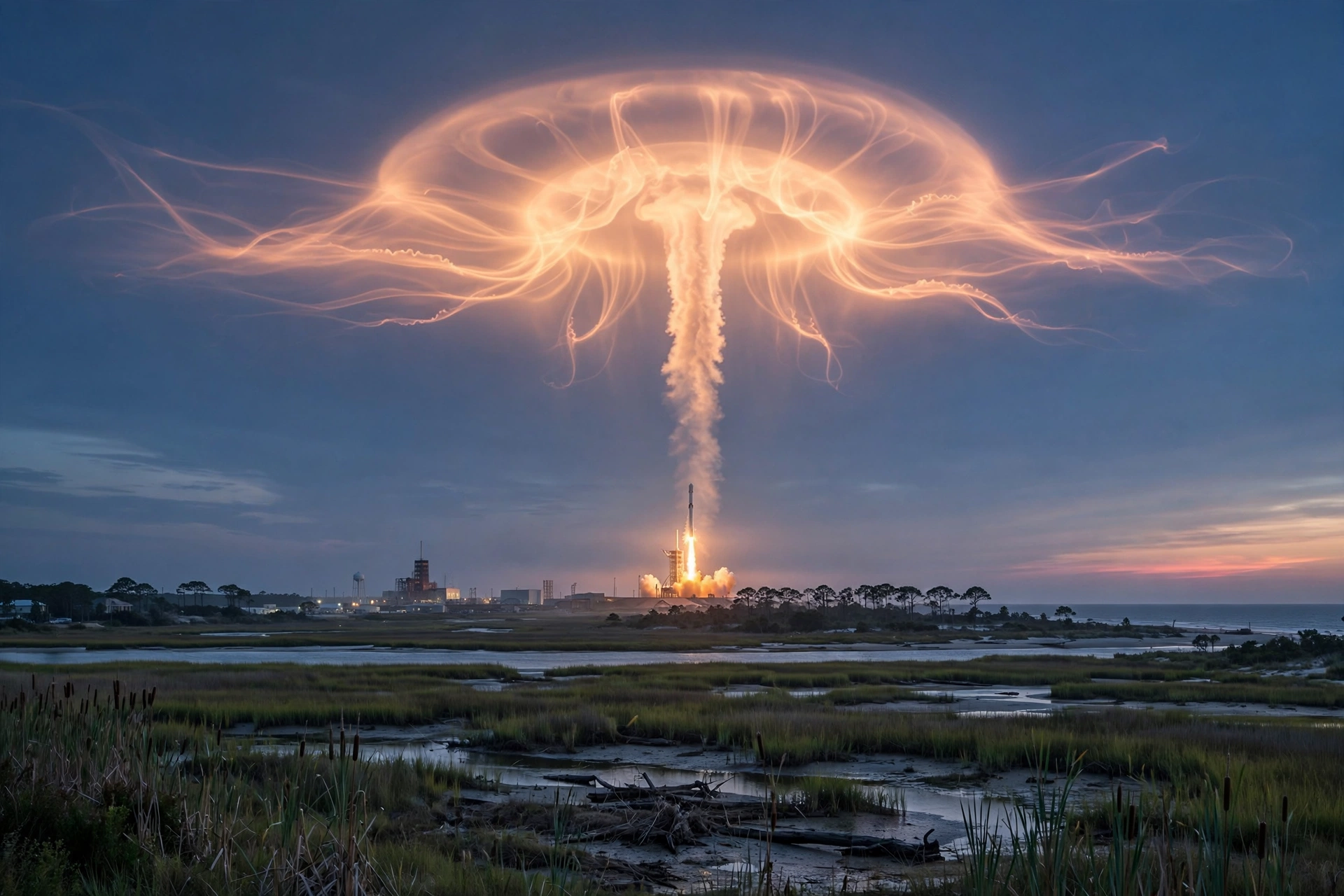
A rocket launch in the early hours briefly turned the sky over the US east coast into something from a science-fiction film this week, as a glowing, translucent shape spread out high above the Atlantic. Photographs shared from Florida to the Carolinas showed a bright centre with long, drifting tendrils — the classic “jellyfish” effect that seasoned launch watchers hope for and first-time viewers rarely forget.
What Created the Jellyfish Shape?
The effect is not smoke in the ordinary sense, and it is not a cloud that formed on its own. It is the rocket’s exhaust plume, expanding in the thin upper atmosphere long after the vehicle has left the launch pad. At ground level, exhaust is squeezed by the surrounding air into a narrow stream. High up, where the air pressure is far lower, that plume can bloom outward into a wide, soft fan.
Timing is what turns a technical effect into a spectacle. When a launch happens shortly before sunrise or just after sunset, the ground below is still dark while the plume, tens of kilometres above it, is already catching sunlight. The contrast is striking: a dark blue sky, a still-sleeping coastline, and a luminous plume glowing white, gold and pale blue above it. Reporting on the latest display by The Guardian captured exactly that contrast, with the cloud visible far from the launch site itself.
Why It Was Visible So Far Away
Distance surprises most people. Because the plume sits so high, it can be seen across a much wider area than the rocket itself. A launch from Florida can produce a sky show for viewers hundreds of miles up the coast, provided the skies are clear and the sun angle is right. That is why social media fills so quickly on mornings like this: people in different states are photographing the same object at the same time, each convinced it must be directly overhead.
It also explains why the shape changes so quickly. Upper-atmosphere winds stretch the plume, the tendrils thin out, and within minutes the crisp jellyfish softens into a faint, wispy streak. If you are following other fast-moving technology stories, our look at quantum computing in 2026 shows the same pattern in a different field — breakthroughs that were laboratory curiosities a few years ago are now visible in everyday life.
How to Catch the Next One
Start with the launch schedule, then work backwards. Dawn and dusk launches offer the best odds, so pick a launch window that falls roughly 30 to 90 minutes before sunrise. Choose a viewing spot with a clear view towards the launch site and as little light pollution as possible — a beach, a lake shore or an open field all work well along the east coast.
Give your eyes time to adjust, and do not stare at your phone. The plume can be subtle at first, brightening as the rocket climbs. A phone camera on night mode will often record more colour than you can see, but resist the urge to watch the whole event through a screen. Photographers recommend a wide shot first, before the plume disperses, then closer frames as the tendrils develop.
More Launches, More Sightings
Sightings like this are becoming more common simply because launches are becoming more common. Commercial launch cadence has risen sharply, and with it the number of dawn and dusk windows that can produce a jellyfish plume. Each new sighting also improves public understanding: what once triggered a flood of puzzled calls to local newsrooms is now quickly identified by experienced sky-watchers online.
That growing familiarity does not make the experience any less remarkable. As our coverage of smart glasses in 2026 notes, technology increasingly blends into the background of daily life — until, occasionally, it does the opposite and stops an entire coastline in its tracks.
The Bottom Line
The jellyfish cloud was a brief, beautiful side effect of a routine piece of physics: expanding exhaust, high altitude and low sunlight combining at exactly the right moment. No special equipment was needed to enjoy it, only clear skies and good timing. With launch schedules staying busy into 2026, east coast residents would do well to keep an eye on dawn launch windows — the next glowing jellyfish may already be on the calendar.
