

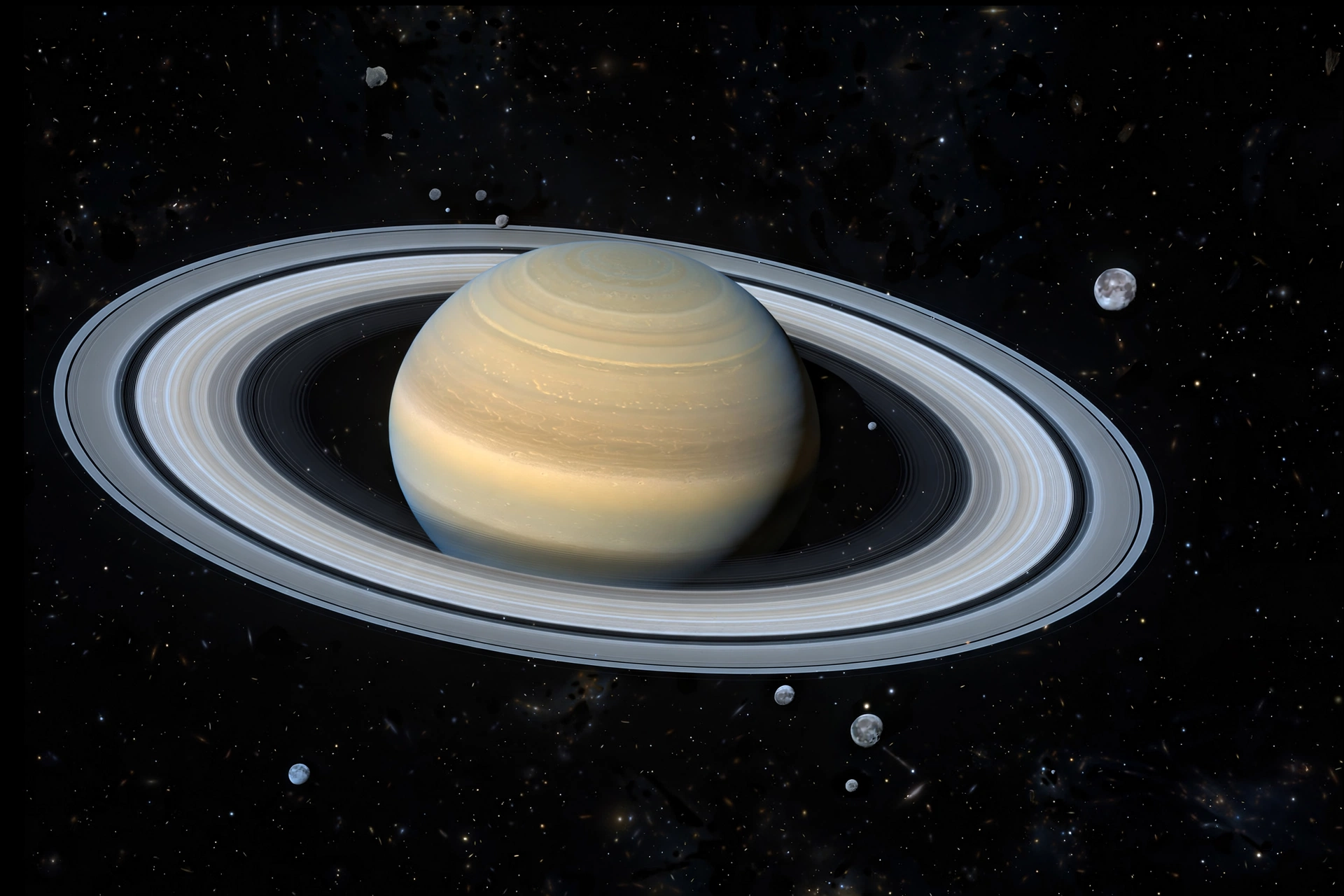
Saturn has quietly broken one of the solar system’s most enjoyable records, and it has done so by an enormous distance. Astronomers have confirmed 128 additional moons around the ringed planet, a haul that lifts its official total to 274. The announcement rewards years of patient telescope work and reminds us that even our nearest planetary neighbours remain surprisingly unexplored. For a planet studied since antiquity, Saturn is still producing discoveries that rewrite the reference books, the record charts and, increasingly, scientists’ accounts of how giant planets gather their orbiting families in the first place.
A total that keeps climbing
Saturn has long been famous for its bright rings, but its family of moons is now the story. The 128 newly confirmed objects take the recognised total to 274, well ahead of Jupiter and every other planet. Most of the additions are small, irregular moons, only a few kilometres across, travelling in tilted, elongated orbits far from the planet itself. They are nothing like the large, familiar worlds such as Titan or Enceladus, yet each one carries clues about collisions and captures that shaped the outer solar system billions of years ago.
How the survey found them
The discoveries come from painstaking work with the Canada-France-Hawaii Telescope, where researchers stacked many long-exposure images so that faint moving objects could emerge from the background stars. Teams linked to the University of British Columbia helped track the candidates over repeated observations, calculating orbits precise enough for formal recognition. That recognition matters: only when the International Astronomical Union accepts an orbit does a candidate become an officially counted moon, rather than a promising smudge in a telescope image. Readers can explore further background from the University of British Columbia, which provides additional context on the research and the institutions involved.
What this means for casual stargazers
You will not see these moons through a backyard telescope; most are far too small and faint, and even Saturn’s brightest satellites require decent equipment. Yet the discovery changes what a simple view of Saturn represents. That steady point of light now stands for a system of at least 274 recognised moons, rings of ancient ice and a gravitational domain millions of kilometres wide. It is a useful corrective to the idea that the solar system was fully catalogued long ago. The catalogue, clearly, is still being written, one faint speck at a time.
Why small moons matter
It is tempting to dismiss a rock three kilometres wide as insignificant, but planetary scientists take the opposite view. Irregular moons are thought to be fragments of larger bodies that broke apart after collisions, or objects captured by Saturn’s gravity early in its history. Their clustered orbits let researchers reconstruct those break-ups, almost like grouping shards from a shattered plate. Studying the groups can reveal how often such impacts happened, how material moved around the young solar system, and why Saturn ended up with such a crowded retinue. For more on a related subject, see our earlier coverage: our report on the SpaceX launch that lit up the East Coast.
What happens next
Confirmation is unlikely to be the final word. Each new survey reaches fainter objects, and astronomers expect still smaller moons to be waiting in the data, below the limit of what current telescopes can separate from noise. Future instruments should push that limit further, while follow-up observations will refine the orbits announced this time. For now, the headline is simple enough: with 274 recognised moons, Saturn’s lead is emphatic, and the planet that schoolchildren draw with rings turns out to be even busier than anyone supposed a generation ago.
The planet of records still has more to reveal, and each addition sharpens the questions astronomers ask about its past. Saturn’s rings made it famous; its ever-growing family of moons may yet make it the most instructive planet of all for understanding how worlds, and the debris around them, come to be.
A note on what counts as a moon
There is no minimum size for a moon, which is why the definition can surprise people. A moon is simply a natural object whose orbit is centred on a planet rather than directly on the Sun, and once that orbit is established securely, size becomes a detail rather than a disqualification. That inclusive rule explains both the excitement and the debate around totals like Saturn’s: critics note that ever-smaller fragments will keep being found as telescopes improve, while supporters answer that a complete census, however far down it reaches, is exactly what a scientific catalogue should attempt.
