

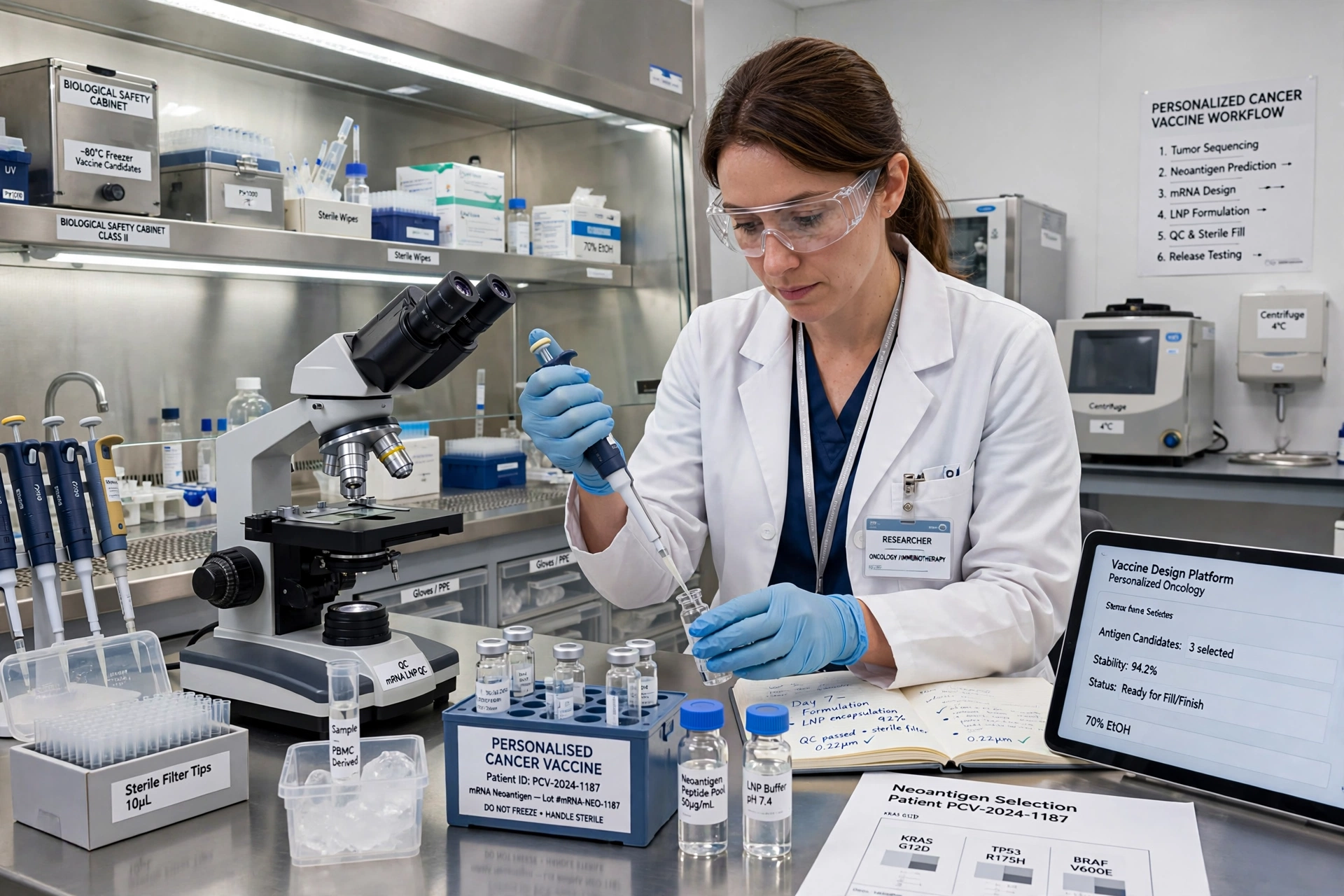
A personalised cancer vaccine has passed an important early test in ovarian cancer, in a small trial designed to check safety and practicality rather than to prove benefit. Published in Nature Medicine, the phase 1 study combined NeoVax — a vaccine tailored to neoantigens found in each patient’s tumour — with the immunotherapy drug nivolumab in people whose disease was platinum-sensitive. The researchers conclude that the approach was feasible and had an acceptable safety profile. That is a meaningful milestone for bespoke cancer medicine, provided it is read for exactly what it is: a beginning.
What the trial set out to test
Phase 1 trials answer a narrow but essential question: can a treatment be given safely, and is the approach practical at all? In this study, published in Nature Medicine, patients with platinum-sensitive ovarian cancer received NeoVax, a vaccine built around neoantigens — abnormal protein fragments produced by their own tumours — alongside nivolumab, an established immunotherapy drug. The researchers report that making and delivering the personalised vaccine was feasible and that the combination showed an acceptable safety profile, an early hurdle that many bespoke cancer treatments fail to clear.
How a personalised vaccine is made
Personalisation is the hard part. Doctors must first sequence tumour tissue to find mutations, predict which resulting fragments the immune system might recognise, manufacture a vaccine matched to that individual, and return it to the clinic while treatment remains relevant. Every step takes time, specialist facilities and money. Demonstrating that the chain can work in real patients, rather than only in theory, is a genuine result from this trial — even though it says nothing yet about whether the vaccine extends life. Readers can explore further background from Nature, which provides additional context on the research and the institutions involved.
What ‘feasible’ really means here
Feasibility sounds like faint praise until you consider the logistics. Each vaccine required tumour sequencing, computer prediction of immune targets, bespoke manufacturing and timely delivery back to the clinic, all coordinated around an individual patient’s care. Many promising personalised therapies stumble on precisely those steps. Showing the full chain can operate for real patients, alongside an established immunotherapy, clears a practical obstacle and justifies the expense of larger studies. It does not, on its own, tell any patient whether the vaccine would help her — the question the next phase must answer.
Why ovarian cancer needs new options
Ovarian cancer is frequently diagnosed late and often returns after initial chemotherapy, even when tumours first respond to platinum-based treatment, as they did for the patients described as platinum-sensitive in this study. Immunotherapy has transformed care for some cancers but has delivered more modest results in ovarian cancer, which is one reason combinations are being explored. Teaching the immune system to recognise tumour-specific targets, while nivolumab releases a brake on immune cells, is a rational strategy — but rational strategies still require proof in larger trials. For more on a related subject, see our earlier coverage: our coverage of glucose monitoring research in diabetes.
Reasons for caution
Nothing in a phase 1 report should be read as evidence that a treatment works. The groups are small, there is usually no comparison arm, and the goals are safety and feasibility rather than survival. Larger randomised studies would need to show that adding NeoVax improves outcomes, for which patients, and at what cost in side effects and resources. Patients should therefore treat the news as a promising scientific step, discuss experimental options only with their oncology team, and be wary of any headline suggesting a cure has arrived.
Ovarian cancer urgently needs better options, and carefully tested innovation is how they will arrive. This trial contributes a solid, unspectacular piece of progress: evidence that an intricate idea can be delivered safely enough to deserve proper testing.
Questions patients often ask
Understandably, patients reading about vaccine trials want to know practical things: could I join a study like this, and what would it involve? Eligibility for early trials is usually narrow — a specific cancer type, a defined treatment history such as platinum-sensitive disease, and general health criteria — and participation involves extra scans, biopsies and visits beyond standard care. Oncologists can advise whether any recruiting trial is appropriate, and reputable trial registries list studies openly. What no early result can do is recommend a treatment outside a trial, which is why personalised advice always has to come from the team who knows the individual case.
