

Most American households accumulate a significant volume of items that are only useful during specific times of year. Patio furniture, winter coats, holiday decorations, lawn equipment, sports gear — these things occupy space when not in use and often end up stored poorly, damaged, or simply forgotten in corners of garages and basements. The challenge isn’t whether to store these items. It’s understanding when to move them, how to prepare them, and where they belong so they remain functional when needed again.
This is a practical concern for homeowners, not a theoretical one. Poor seasonal rotation leads to real consequences: items that deteriorate from improper storage, living spaces that feel cluttered year-round, and the recurring frustration of retrieving damaged goods at the start of a new season. A structured approach to seasonal storage removes that friction and protects the investment homeowners make in their belongings.
Why a Seasonal Storage Framework Matters More Than General Decluttering
Decluttering is about removing what you no longer need. Seasonal storage is about rotating what you do need but not right now. These are fundamentally different activities, and conflating them leads to disorganized homes where useful items are either discarded prematurely or stored haphazardly without a system. A proper framework for seasonal storage solutions treats your belongings as a managed inventory — one that shifts based on time of year, climate conditions, and practical demand. For homeowners who want to understand the full scope of what this involves across different seasons, exploring structured guidance on seasonal storage solutions offers a grounded starting point.
The value of a framework is that it removes decision fatigue. Rather than asking “where should this go?” every time a season changes, a working system tells you. It defines categories, assigns timelines, and establishes storage conditions — so the process becomes repeatable rather than reactive.
The Difference Between Rotating and Storing Indefinitely
One of the most common storage mistakes is treating seasonal items the same as long-term stored items. A winter coat that gets swapped out in March will be retrieved in October. A box of holiday ornaments will be opened in November and returned in January. These items need to be stored in a way that makes retrieval easy and keeps them in usable condition — not buried behind boxes that won’t be touched for years.
Long-term storage, by contrast, applies to items you’re keeping but not accessing regularly. Furniture from a spare room, heirloom items, archival documents — these follow different preparation and placement rules. Understanding this distinction helps homeowners allocate storage space more intelligently and avoid the situation where seasonal items become inaccessible because they’ve been packed behind everything else.
The Four-Season Storage Checklist: What to Move and When
Seasonal storage follows the rhythm of the calendar, but the timing is driven more by weather patterns and practical use than by the official first day of each season. A useful checklist accounts for what needs to be stored, what needs to come out, and what condition those items should be in before they’re packed away.
Spring Transition: Moving Winter Items Out and Summer Items In
The spring transition typically begins when consistent overnight temperatures rise above freezing and outdoor activity resumes. At this point, a range of winter-specific items can be moved into storage while warm-weather gear is brought back into regular use.
Items to store in spring:
• Heavy winter coats, wool blankets, and thermal clothing — cleaned and sealed in breathable storage bags to prevent moisture buildup and pest infiltration
• Snow blowers, ice melt spreaders, and cold-weather maintenance equipment — drained of fuel where applicable and stored in a dry location away from temperature extremes
• Winter boots and insulated footwear — cleaned, dried thoroughly, and stored in labeled containers to prevent deformation and odor
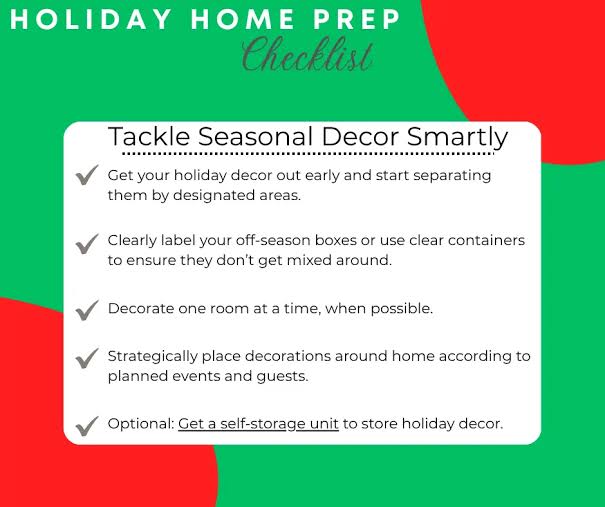
• Holiday and winter decorative items — packed carefully with padding to protect fragile elements
Items to retrieve in spring:
• Patio and outdoor furniture — inspected for any damage that may have occurred in storage before being placed outside
• Garden tools, hoses, and irrigation equipment — checked for cracks or wear caused by cold exposure during storage
• Bicycles, outdoor sports equipment, and recreational gear — inflated, lubricated, and tested before first use
Fall Transition: Protecting Summer Items and Preparing for Cold Weather
The fall transition mirrors the spring process in reverse. As temperatures drop and outdoor living shifts indoors, summer-specific items need to be cleaned, inspected, and stored before winter conditions affect them. This is often the more critical transition because cold weather can permanently damage items left outdoors or in uninsulated spaces.
Items to store in fall:
• Outdoor furniture — cleaned of debris, dried completely, and stored in covered or indoor spaces to prevent weather damage and UV degradation
• Gas-powered lawn equipment — fuel systems stabilized or drained, blades cleaned, and stored in a sheltered, ventilated area
• Garden hoses, sprinkler heads, and irrigation components — drained and stored to prevent freeze-cracking
• Summer clothing and lightweight footwear — laundered before storage to prevent staining from oils and perspiration setting over months
• Pools, inflatables, and water recreation equipment — fully dried before packing to prevent mold and material degradation
Items to retrieve in fall:
• Winter clothing layers, including coats, scarves, and insulated footwear — inspected for any wear before the cold season begins
• Snow removal equipment — serviced and tested before first use
• Heating equipment such as portable space heaters — checked for safety compliance before operation, in line with guidance from the U.S. Consumer Product Safety Commission
Choosing the Right Storage Location for Different Item Categories
Where you store an item is as important as how you store it. Temperature, humidity, light exposure, and accessibility all affect whether an item remains in good condition over a storage period. Not every item belongs in the same location, and matching the item to the appropriate environment reduces the risk of deterioration.
Indoor Storage: Closets, Basements, and Attics
Indoor storage is convenient but comes with environmental trade-offs. Attics can reach extreme temperatures in summer and fall below freezing in winter — conditions that damage electronics, wooden items, photographs, and certain fabrics. Basements, while temperature-stable in many climates, carry moisture risk that threatens textiles, paper, and metal items prone to rust. Closets are practical for seasonal clothing but have limited capacity and variable airflow.
The key is matching the item’s sensitivity to the storage environment’s actual conditions, not its perceived convenience. A winter coat stored in a damp basement may emerge in October with mildew. A box of photographs stored in a hot attic for a summer may suffer irreversible yellowing and warping.
Garage Storage: Practical but Often Misused
Garages are among the most used and most poorly organized storage spaces in American homes. They’re appropriate for large equipment, tools, sports gear, and vehicles — but are frequently used as overflow storage for items that don’t belong there. Humidity, temperature swings, pests, and limited organization often mean items deteriorate or become difficult to locate.
Effective garage storage relies on vertical organization systems, sealed containers, and clear labeling. Items stored on the floor or in open bins are vulnerable to moisture and pests. Seasonal items in a garage should be grouped by category and placed in a retrieval sequence that reflects when they’ll be needed next.
Off-Site Storage: When Home Space Is Insufficient
Many households reach a point where the volume of seasonal items exceeds what can be reasonably managed at home. Off-site storage units offer a controlled environment for overflow, and they work particularly well for large items like outdoor furniture sets, recreational vehicles, seasonal sporting equipment, and furniture from transitional household changes.
The decision to use off-site storage should be based on a clear inventory of what’s being stored, how frequently it needs to be accessed, and what environmental conditions it requires. Climate-controlled units are appropriate for sensitive items including electronics, artwork, and materials prone to humidity damage. Standard units suit durable items like tools, furniture, and seasonal outdoor equipment.
Preparation Standards That Protect Items During Storage
How an item is prepared before being stored determines its condition when retrieved. The most common storage failures come not from poor facilities or inadequate containers, but from items being stored in a state that causes damage over time — damp fabric developing mold, fuel-contaminated equipment corroding internally, or unwashed clothing developing permanent stains.
Before any item goes into seasonal storage:
• Clean it thoroughly — residue, soil, oil, and food traces accelerate material breakdown and attract pests
• Dry it completely — moisture trapped inside containers creates ideal conditions for mold and corrosion regardless of the external environment
• Inspect it — identifying damage before storage ensures you don’t retrieve a broken item months later when you need it most
• Label it clearly — include both the contents and the season it belongs to, so retrieval is direct and doesn’t require unpacking multiple containers
• Choose appropriate containers — breathable bags for clothing and textiles, sealed hard containers for electronics and fragile items, and vented storage for equipment that may off-gas or require airflow
Closing: Building a Storage System That Works Year After Year
A seasonal storage checklist is only as useful as the system behind it. Going through the motions of moving items twice a year without a consistent framework leads to gradual disorder — containers without labels, locations that shift each season, and items that get retrieved damaged or not at all. The households that manage this well aren’t necessarily the ones with the most space. They’re the ones that treat seasonal rotation as a repeatable process with defined steps.
The checklist presented here covers the core transitions — spring and fall — along with the storage conditions and preparation standards that protect what you own. The goal isn’t perfection in any single season. It’s consistency across all of them. When a system is in place, the twice-yearly effort of rotating seasonal items becomes routine rather than disruptive, and the quality of what you retrieve at the start of each new season reflects the care taken the last time you stored it.
Start with an honest inventory of what you’re storing, where it’s currently living, and whether those locations are appropriate for the items and the season ahead. From there, the framework builds itself.
