

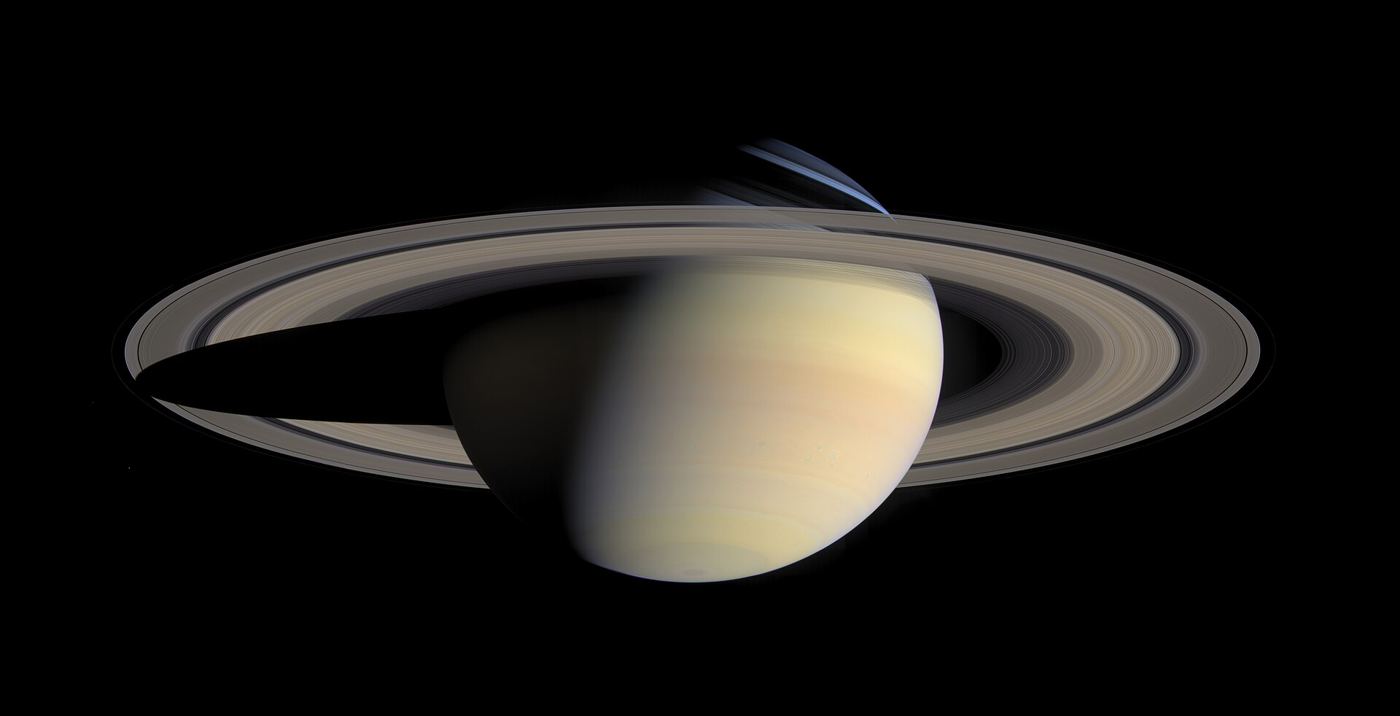
Saturn’s rings are the most famous sight in the solar system, a broad shining disc that makes the planet look like a jewel in a telescope. Up close, though, the rings are not a solid band at all. They are made of countless separate chunks of ice, ranging from grains of dust to lumps the size of houses, all orbiting the planet in a thin flat sheet. The particles are mostly water ice, with a little rock mixed in, and their surfaces are so bright and clean that they reflect sunlight brilliantly. The whole system is enormous, stretching more than two hundred thousand kilometres across, yet in places it is only about ten metres thick. If the rings were shrunk to the size of a dinner plate, they would be thinner than a sheet of paper.
What the Evidence Shows
Astronomers still argue about where the rings came from and how long they will last. One leading idea is that an icy moon wandered too close to Saturn and was torn apart by the planet’s gravity, its fragments spreading into the rings we see today. Another is that the rings are the leftover rubble of comets that broke up long ago. Data from the Cassini spacecraft, which flew through the rings’ gaps before its mission ended in 2017, showed that the rings are slowly raining ice down into Saturn’s atmosphere, which suggests they may be younger than the planet itself and could fade over the next hundred million years. Whatever their fate, the rings remain a reminder that the solar system’s most beautiful structures can be made of the simplest material: ordinary ice, endlessly circling a giant world. Reporting and analysis from sources such as National Science Foundation track the same developments, and specialists following the saturn’s rings made of countless chunks of ice say the direction is now consistent across independent lines of evidence.
The Wider Context
The wider context is a research landscape in which replication and open data now decide reputations. Findings connected to the saturn’s rings made of countless chunks of ice are being checked by independent groups with shared datasets, and the teams involved publish their methods in full so rivals can test every step. That discipline is slower than a headline cycle, but it is why results in this area increasingly survive first contact with scrutiny.
What Happens Next
What happens next in the story of the saturn’s rings made of countless chunks of ice will be decided by follow-up work already under way: larger samples, longer observation and instruments that have not yet come online. The researchers involved are unusually united on one point, that the current results justify the next investment of time and money. Readers will not have to wait long for the first tests of that claim. You can follow related developments in our coverage of science.
There is a practical lesson in all of this for readers deciding what to do today. Start with the verified facts, be wary of anyone promising certainty, and prefer reversible steps while the evidence is still developing. Circumstances differ by country, income and personal situation, so general guidance should always be weighed against your own context before you act on it in any significant or lasting way.
