

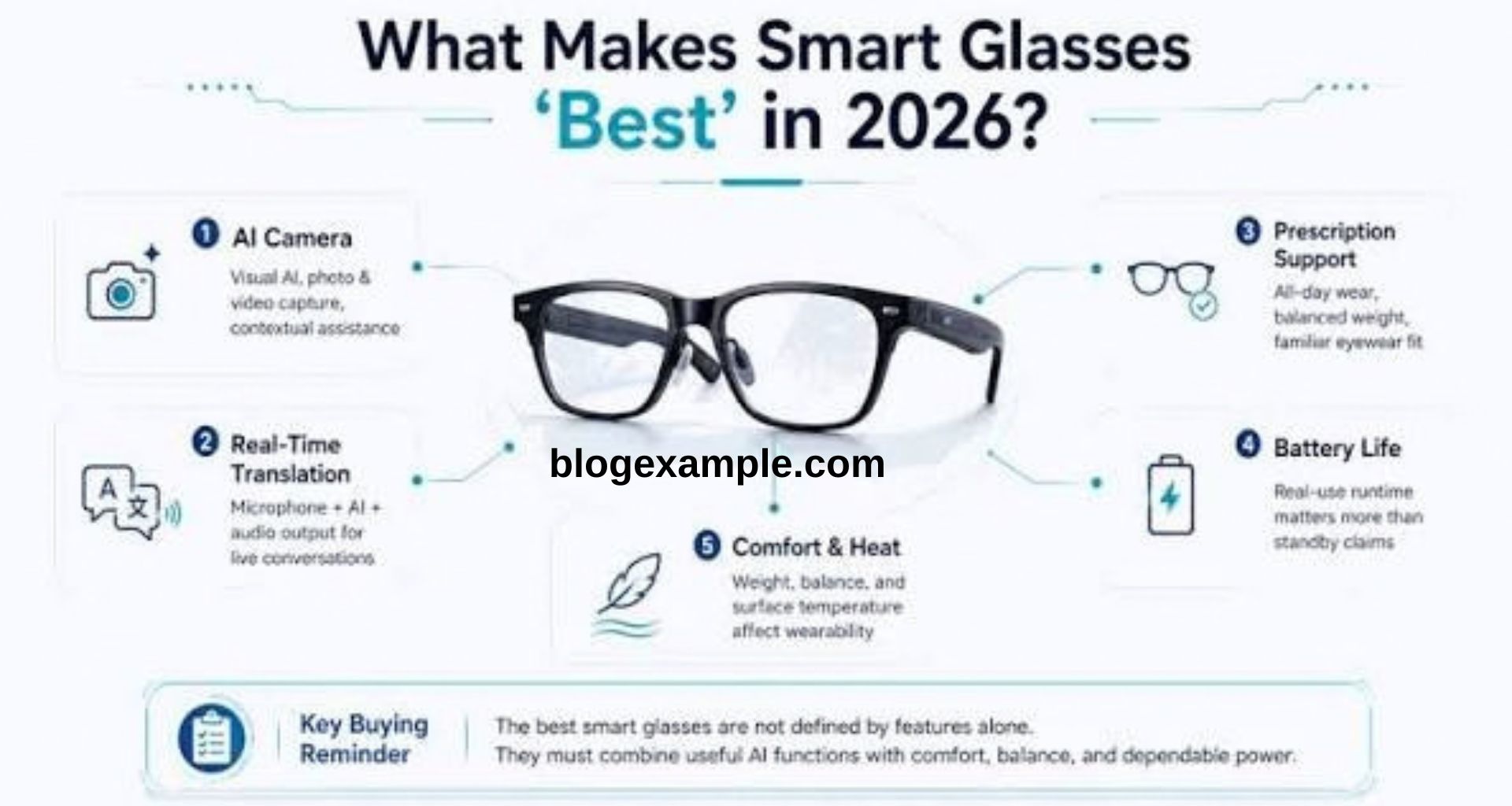
Smart glasses are becoming one of the most interesting wearable technology trends in 2026. What once looked like a futuristic concept is now moving closer to an everyday device. Modern smart glasses combine lightweight eyewear with artificial intelligence, cameras, microphones, speakers, connectivity and voice assistants. The result is a hands-free technology experience that can support communication, entertainment, navigation and productivity.
The biggest change in 2026 is the growing role of AI. Earlier smart glasses mainly focused on music, calls and basic camera functions. Newer models can understand spoken questions, recognize objects, describe surroundings, translate information and provide useful answers without requiring users to reach for a smartphone. As AI becomes more capable, smart glasses are also becoming more practical. They can potentially reduce the need to constantly check a phone while walking, working, traveling or completing everyday tasks. This article explores the major smart glasses features in 2026, including AI capabilities, cameras, privacy considerations, everyday uses and the future of wearable computing.
Read More: AI-Powered PCs: New Features Changing the Future of Personal Computing
What Are Smart Glasses?
Smart glasses are wearable devices designed to look similar to regular glasses while adding digital technology. Depending on the model, they may include cameras, microphones, speakers, touch controls, wireless connectivity and AI-powered software. Some smart glasses focus on audio and voice interaction, while others provide visual information directly through lenses. Augmented reality glasses go further by placing digital content into the user’s field of view.
The category is becoming more diverse. Instead of one standard design, consumers can now find smart glasses aimed at communication, entertainment, photography, accessibility, fitness, navigation and professional work.
AI Is the Biggest Smart Glasses Trend in 2026
Artificial intelligence is changing what smart glasses can do. Instead of functioning as simple Bluetooth accessories, AI-powered glasses can act more like personal assistants. Users can speak naturally to their glasses and ask questions. AI can process the request and provide an answer through built-in speakers or another connected device.
Modern AI features can include:
- Voice-based questions and answers
- Object and scene recognition
- Image understanding
- Text recognition
- Language translation
- Voice reminders
- Personalized assistance
- Visual search
- Hands-free information access
For example, a person visiting a new place could ask the glasses to explain what they are looking at. A traveler could use translation features to understand signs or menus. Someone shopping could ask an AI assistant to identify an object or provide information about it. This shift from smartphone interaction to natural voice interaction could become one of the defining developments in wearable technology.
Cameras Are Becoming More Useful
Cameras remain one of the most recognizable features of modern smart glasses. A small camera mounted near the frame can capture photos and videos from the wearer’s point of view. This creates a more natural way to record moments. Instead of taking out a smartphone, users can capture a photo through a voice command or physical control.
Smart glasses cameras can be useful for:
- Recording travel experiences
- Capturing family moments
- Creating social media content
- Documenting work activities
- Taking quick photographs
- Supporting AI visual recognition
- Recording short videos
The camera also plays an important role in AI functionality. When combined with computer vision, it can help the glasses understand what the wearer is seeing. For example, AI may analyze an object captured by the camera and provide information about it. This makes the camera more than a simple photography tool.
Hands-Free Communication
Communication is another major area where smart glasses can provide practical benefits. Built-in microphones and speakers can allow users to make calls without holding a phone. Voice controls can also help users send messages, listen to notifications or interact with digital assistants.
This could be especially useful when a person’s hands are busy. Someone cooking, walking, repairing equipment or carrying items may prefer speaking to a wearable device instead of reaching for a smartphone. Open-ear audio technology can also allow users to hear sound while remaining aware of their surroundings.
Smart Glasses for Navigation
Navigation could become one of the most useful applications of smart glasses. Traditional navigation usually requires looking down at a smartphone. Smart glasses could provide directions through audio or, in more advanced systems, visual overlays.
Imagine walking through an unfamiliar city while receiving directions without repeatedly checking a phone. Audio instructions could tell the user when to turn, while augmented reality glasses could potentially display directional indicators in the user’s field of view. For travelers, this could make navigation more convenient and reduce the amount of attention required from a handheld screen.
Translation in Real Time
Language translation is another area where AI-powered smart glasses could have a major impact. A user may encounter a sign, menu or conversation in another language. With a camera, microphone and AI system, smart glasses can potentially recognize the information and provide a translation.
Voice translation can also make conversations easier between people who speak different languages. Real-time translation technology is still developing, and accuracy can vary depending on language, background noise and internet connectivity. However, improvements in AI are making wearable translation increasingly realistic.
Smart Glasses for Work and Productivity
Smart glasses are not limited to entertainment. They can also support professional tasks. Workers may use smart glasses for hands-free instructions, remote assistance, documentation and information access. In industrial environments, workers could potentially receive instructions without stopping their work to check a computer or phone.
Professionals in fields such as logistics, maintenance, manufacturing and healthcare may benefit from wearable information systems. For office workers, audio-focused smart glasses could provide reminders, calls and voice assistance without requiring constant interaction with a laptop or smartphone. The long-term goal is simple: provide useful information when it is needed while reducing unnecessary screen interaction.
Accessibility Benefits
Smart glasses could also become an important accessibility technology. AI-powered vision features may help users understand objects, read text or identify visual information. Audio descriptions can potentially make parts of the surrounding environment easier to understand.
For people who have difficulty reading small text, smart glasses may assist by recognizing written information and converting it into spoken language. These applications are still evolving, but they demonstrate how wearable AI can move beyond convenience and provide meaningful support in daily life.
Entertainment and Social Media
Entertainment remains an important part of the smart glasses market. Users can listen to music, podcasts and calls through built-in speakers. Cameras can also make it easier to create short videos and photos from a first-person perspective.
Content creators may find smart glasses useful because they can capture moments without holding a camera. This can create a more natural style of content. However, responsible use is important. Recording people without their knowledge can create privacy concerns, especially in schools, workplaces, private properties and other sensitive environments.
Privacy Is a Major Concern
The growth of camera-equipped smart glasses also raises important privacy questions. A smartphone camera is usually easy to identify because users hold the phone directly in front of them. A camera built into glasses can be less obvious.
Manufacturers have therefore been working on visible recording indicators and privacy controls. Users also need to follow local laws and respect the privacy of other people. AI creates additional concerns because images, voice recordings and other information may be processed by cloud services or connected applications.
Before buying smart glasses, consumers should understand:
- What information the device collects
- Where data is processed
- Whether recordings are stored
- How long data is retained
- What privacy controls are available
- Which apps receive access to information
Privacy will likely remain one of the biggest challenges facing wearable AI.
Battery Life and Connectivity
Smart glasses need to balance advanced features with small physical dimensions. Cameras, microphones, speakers and AI processing require energy, but consumers expect glasses to remain lightweight. Battery life therefore remains an important consideration.
Some devices rely heavily on a connected smartphone or cloud services. Others are beginning to include more processing directly within the wearable device.
Improved chips and energy-efficient AI systems could help future smart glasses deliver more features without requiring larger batteries. Connectivity is also important. Features that depend on cloud-based AI may require an internet connection, while basic functions can sometimes work without constant connectivity.
How Smart Glasses Could Change Smartphone Use
Smart glasses are unlikely to completely replace smartphones in the near future. Phones still provide large displays, powerful applications, advanced cameras and convenient typing. However, smart glasses could reduce the number of times people need to reach for their phones.
A user might check a notification through audio, ask a quick question, take a photograph or receive navigation instructions without opening a smartphone. This creates a new computing model where the phone remains the central device while smart glasses provide a more natural interface.
Over time, this relationship could change as wearable hardware becomes more powerful.
Challenges Facing Smart Glasses in 2026
Despite rapid progress, smart glasses still have limitations. Price is one major issue. Advanced hardware and AI capabilities can make smart glasses more expensive than conventional eyewear.
Battery life is another challenge. Users expect glasses to remain comfortable throughout the day, making large batteries impractical. AI accuracy also matters. An assistant that misunderstands questions or incorrectly identifies objects can quickly become frustrating.
Design is equally important. Consumers may not want technology that looks bulky or unusual. Successful smart glasses need to look and feel like normal eyewear. Privacy, durability, software support and prescription lens compatibility are additional factors buyers need to consider.
The Future of Smart Glasses
The future of smart glasses will likely depend on better AI, smaller components and more efficient batteries. As AI models become more capable, glasses may understand context rather than simply respond to individual commands. Instead of asking a device every question, users may receive relevant information automatically.
Augmented reality could also become more practical as displays improve. Lightweight glasses could eventually combine AI assistance with navigation, communication and digital information directly in the user’s field of view. Another important development will be on-device AI. Processing information locally can improve responsiveness and potentially reduce the amount of personal data sent to cloud servers.
The most successful smart glasses will probably be the ones that make technology feel less intrusive rather than adding another complicated screen to everyday life.
Frequently Asked Questions
What are smart glasses?
Smart glasses are wearable devices that look like regular glasses but include technology such as cameras, microphones, speakers, wireless connectivity and AI features.
What can smart glasses do in 2026?
Modern smart glasses can support voice assistants, photography, video recording, calls, music, AI questions, object recognition, translation and other hands-free functions.
Do smart glasses have cameras?
Many modern smart glasses include small cameras for photos, videos and AI-powered visual features. Not every smart glasses model has a camera.
Can smart glasses use AI?
Yes. AI-powered smart glasses can understand voice commands, answer questions, analyze images, recognize objects and provide other forms of assistance.
Are smart glasses replacing smartphones?
Smart glasses are not expected to completely replace smartphones soon. They are more likely to work alongside smartphones by providing hands-free access to selected features.
Are smart glasses useful for travel?
Yes. Smart glasses can support photography, navigation, translation, communication and AI-based information while traveling.
Do smart glasses raise privacy concerns?
Yes. Camera-equipped glasses can create privacy concerns because they can record images or video in public and private environments. Users should follow laws and respect other people’s privacy.
What is the future of smart glasses?
Future smart glasses are expected to become lighter, more intelligent and more energy efficient. AI, augmented reality and on-device processing could make them increasingly useful.
Conclusion
Smart glasses in 2026 are moving beyond simple wearable gadgets. AI features, cameras, voice assistants, translation, navigation and hands-free communication are making them increasingly useful for everyday activities. Their greatest advantage is convenience. Users can access information, capture images, communicate and interact with AI without constantly holding a smartphone. At the same time, challenges involving privacy, battery life, price, design and AI accuracy remain important. Smart glasses are still developing, but their direction is clear: computing is becoming more personal, portable and hands-free.
